Tennis Serve Video Analysis: Two Views for Toss and Contact
Film a tennis serve from the side and behind the baseline. Keep the toss in frame and compare the release, contact interval and recovery across similar serves.
Read the filming planA serve can land in the intended zone while its contact is hidden above the frame. It can also look tidy in a close-up that never shows the result. Collect the view that answers your question, and retain enough context to connect the movement with its intended target.
Use a fixed side-oblique camera outside the court, leaving room for the entire toss and contact. Keep a separate wider view when you need the target and landing. Compare the same serve type and intended zone, then label any contact or ball travel that the camera does not resolve.
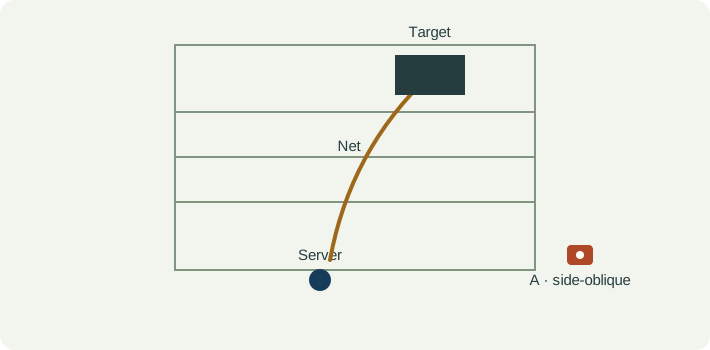
Place the phone beyond the court and all movement space, not on the service line. Include the feet, entire toss, striking hand and finish. Check the framing with a complete motion before recording the practice segment.
When landing zone is the question, use a separate wider set that includes the far court. Keep the original technique view as well; a wide image may make the hand-ball contact too small to inspect.
Label standing or jump serve and the intended target. Record wind or other changing conditions when relevant. Do not compare different serve tasks as if they were a controlled before-and-after pair.
| Event | What to keep visible | Review question |
|---|---|---|
| Toss release | The ball leaving the hand with the full player visible. | Does the same view show a repeatable release situation? |
| Toss and approach | The ball's visible travel plus any approach steps. | Did the camera retain the whole action or cut it at the highest point? |
| Contact interval | The last visible hand-ball overlap and the first unobstructed ball travel. | Can you identify the same interval in both chosen clips? |
| Finish and target | The player's recovery and, in the wider view, the recorded landing region. | Was the intended target the same, and was the landing actually captured? |
| Observation | Interpretation to check | Next useful action |
|---|---|---|
| The toss goes above the recording | The comparison loses part of the action. | Leave more headroom or move farther back while keeping contact readable. |
| The ball blends into the wall or lights | Tracking may become uncertain even when the player is clear. | Use a view with better contrast and inspect the original ball frames. |
| A serve lands long in one clip | Target, conditions or task may differ. | Read the intent and context notes before attributing the outcome to a body position. |
| The ball exits the image before landing | The clip cannot establish the landing result. | Use a separate wider view for the target question. |
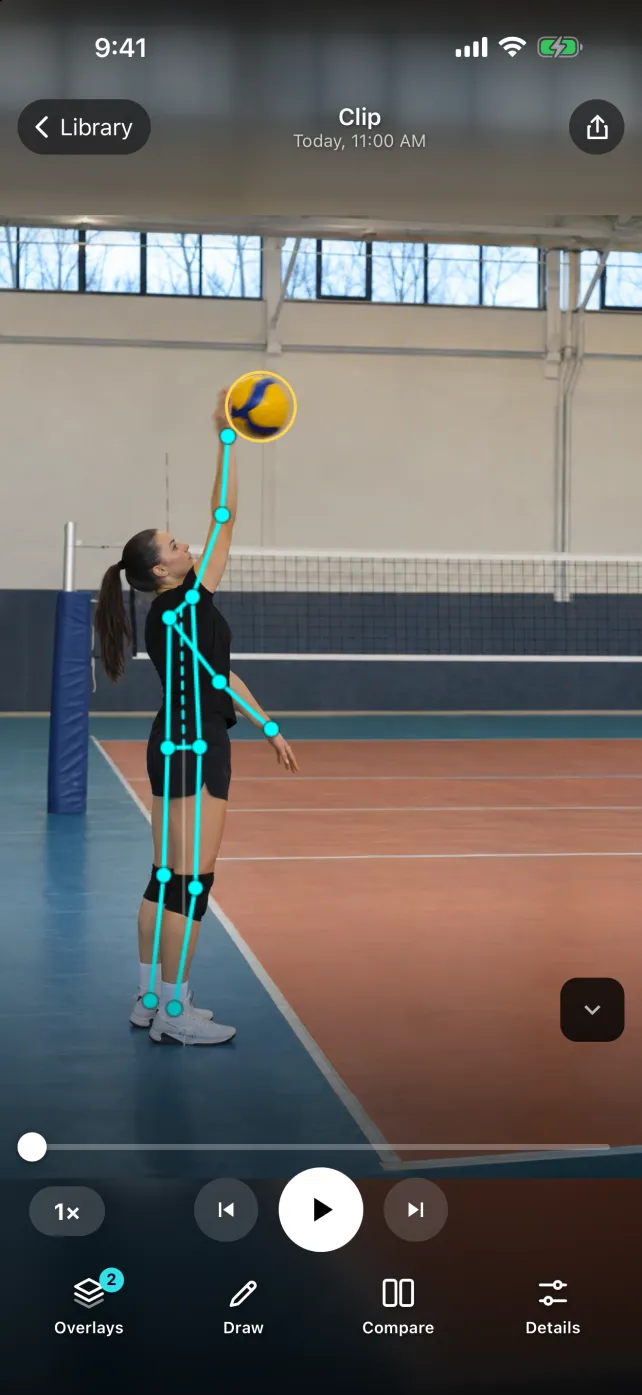
In SportsDraw 1.1.0, step through the toss and contact before adding a body overlay or ball trail. Use comparison on clips with matching serve type and framing. When sharing, include a short lead-in and finish so the marked contact frame remains connected to the complete attempt.
See what SportsDraw can do · See SportsDraw on the App Store
A phone-view trail is not a radar speed reading, spin calculation or proof of a float-serve effect. A side-oblique body image also does not establish three-dimensional shoulder or elbow angles. Use visible sequences and target outcomes as coaching context; keep unobserved parts explicitly unknown.
Slower playback does not add frames that the camera never recorded. If contact is hidden or falls between frames, preserve that uncertainty in your note. See frame timing explained.
https://sportsdraw.app/posts/volleyball-serve-video-review
This worksheet stays in this page. Copy or print it to keep it; its contents are not sent to us.
Standing serve · same deep target · side-oblique view · toss and contact clear · landing outside frame · keep target outcome as a separate note.
This article is published by the app developer as a filming-and-review workflow. Camera diagrams and example notes are illustrative. They are not athlete test results or an individual coaching assessment. Coaching context was checked against the primary resources below on November 8, 2026.
Primary coaching context for intentional serving practice and target selection. The camera, uncertainty and matched-rep review protocol is original to this guide.
Film a tennis serve from the side and behind the baseline. Keep the toss in frame and compare the release, contact interval and recovery across similar serves.
Read the filming planReview basketball shooting form with fixed side and rear-oblique camera views. Compare a matched gather, release interval and landing without inventing an ideal angle.
Read the filming planAll sports video-review guides · Baseball and other practice articles