
Soccer Shooting Video Analysis: Film the Strike and Ball Path
Film a soccer shot with the kicking foot, ball and goal visible. Review approach, contact and the early ball path using a repeatable phone-video checklist.
Read the filming planA close-up of fast feet can hide where the player is trying to go. Start with a wider, fixed view so the approach, turn and exit stay in the same clip. The goal is to make a specific touch easier to discuss, not to award a technique score from a highlight.
Follow one change of direction from the touch before the turn through the first touches out of it. Film the whole lane from a fixed position, keep the feet and ball distinct, and compare the same turn direction and starting conditions. Cone practice and play against a defender answer different questions.
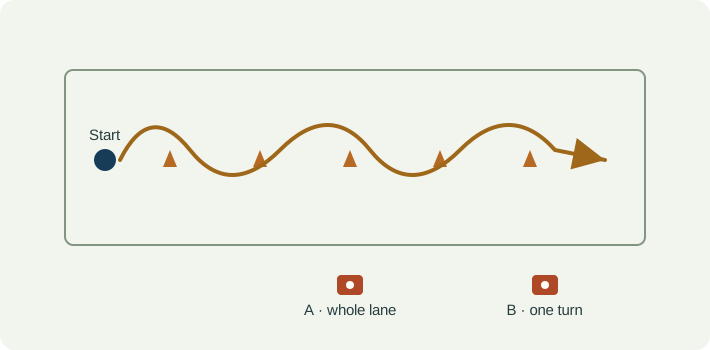
Place the camera outside the practice area and far enough back to see every cone used in the recorded section. Let the player travel across the frame instead of straight toward the lens. Keep the ball, shoes and space beyond the last cone visible.
For a separate set, frame a single cone and the approach and exit around it. Show the player from head to foot. This is useful when a wide clip makes the ball too small to inspect.
Write down cone spacing, turn direction and whether the practice includes a defender. Reuse the same layout for a later comparison. Put the phone where neither the player nor a loose ball needs to pass it.
| Event | What to keep visible | Review question |
|---|---|---|
| Before the turn | The touch leading into the cone and the space between foot and ball. | Does the player arrive with the ball in a similar visible position? |
| Direction change | The visible foot-ball interaction and the ball's new direction. | Can you identify the touch that changed direction, or is it hidden? |
| Exit | The next two visible touches and the route into open space. | Does the ball stay in the intended lane without a recovery detour? |
| Head and surroundings | Only the head positions and nearby players that the camera actually captures. | What is visible about the situation? A head position alone does not prove where the player looked. |
| Observation | Interpretation to check | Next useful action |
|---|---|---|
| The player is tiny in a wide clip | The full route is visible but individual touches are not. | Keep the wide clip for context and film a separate close view of one turn. |
| The ball repeatedly vanishes between the feet | Occlusion is making a track unreliable. | Check the unannotated clip and adjust the camera angle; do not trust an uninterrupted-looking overlay. |
| A quicker run also has more recovery touches | Completion time and control describe different parts of the attempt. | Write down both the outcome and the visible touch sequence. |
| Two turns look different | Direction, entry pace or cone spacing may have changed. | Match the drill conditions before interpreting a technique difference. |
In SportsDraw 1.1.0, use a short ball trail so separate touches remain readable. Inspect any place where the ball crosses a shoe or cone. A body overlay can help you locate the player, but it does not prove that a turn is technically correct. Compare the same cone and turn direction in both clips.
See what SportsDraw can do · See SportsDraw on the App Store
England Football Learning describes dribbling as keeping the ball while moving, including moving into space and changing direction. Our review focuses on what the camera shows about those actions. It cannot infer the player's gaze, decision quality or match readiness from feet-only footage. A path on the image is also not a calibrated ground-speed measurement.
Slower playback does not add frames that the camera never recorded. If contact is hidden or falls between frames, preserve that uncertainty in your note. See frame timing explained.
https://sportsdraw.app/posts/soccer-dribbling-video-review
This worksheet stays in this page. Copy or print it to keep it; its contents are not sent to us.
Right turn at cone 3 · same lane · ball hidden at turning touch · exit needed two recovery touches · get a clearer detail view.
This article is published by the app developer as a filming-and-review workflow. Camera diagrams and example notes are illustrative. They are not athlete test results or an individual coaching assessment. Coaching context was checked against the primary resources below on November 8, 2026.
The governing body's explanation supplies the skill context; the filming setup and comparison protocol are this guide's original workflow.
Film a soccer shot with the kicking foot, ball and goal visible. Review approach, contact and the early ball path using a repeatable phone-video checklist.
Read the filming planFilm a non-contact football route with the full body and break point visible. Compare matched stems, cuts and exits without losing the feet or catch context.
Read the filming planAll sports video-review guides · Baseball and other practice articles