Gymnastics Routine Video Review: Keep the Whole Sequence Visible
A camera plan for private gymnastics routine review: frame the full movement, preserve the approach and finish, and make a clear note for your coach.
Read the filming planTwo paused poses can look different because the dancers are on different counts. A front-camera preview can also reverse the direction you think you are checking. This guide helps you record a familiar phrase and make a clear observation to discuss with your teacher, whether you practise choreography, a recital piece or a short class combination.
Record the same phrase from the same audience-facing view, with hands and feet visible throughout. Label whether either recording is mirrored. Find a shared count or movement in each take before comparing positions, then watch the full phrase at normal speed for its timing and transitions.
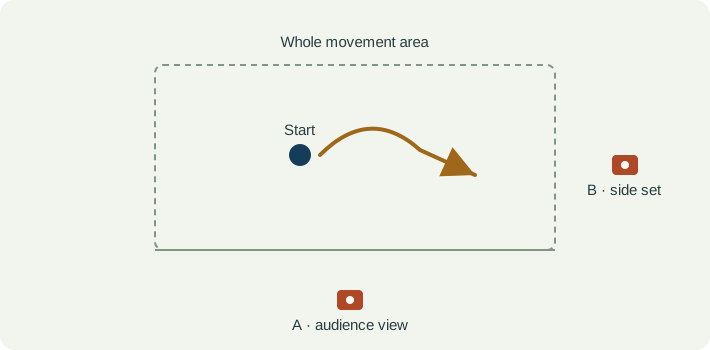
Choose an approved filming spot in front of the practice area. Keep the phone level on a stable support and test the complete phrase once to check the frame. Leave room above the highest reach and below the feet, plus space for travel to both sides. A close portrait crop may make expressions clearer while hiding the footwork you wanted to review.
Use the same camera and orientation for both takes. Write “audience view” or “mirrored” in your note after checking the saved recording, rather than assuming that it matches the preview. If your reference is mirrored, establish which of your own sides corresponds to it before comparing. A clear starting-side label is more useful than a guessed left or right.
An audience view keeps the phrase understandable. A separate side view may make an overlapping arm or a depth change visible, but it is a different take unless you actually recorded both views together. Ask the teacher where to stand and keep the support outside the travelling path. Do not use a mirror reflection as an additional calibrated camera angle.
| Event | What to keep visible | Review question |
|---|---|---|
| Start of the phrase | A recognisable starting position and the first movement, before travel begins. | Are both takes starting from the same side and the same part of the music? |
| A chosen count | The whole body and a floor or wall reference that stays fixed. | Am I comparing the same event, or one take just before it and the other just after it? |
| Transition | The movement into and away from the selected position. | Does the difference remain when I watch the surrounding sequence? |
| End of the phrase | The final position and the following recovery, without cutting early. | Did the camera retain the complete phrase or lose a hand, foot or travelling section? |
| Observation | Interpretation to check | Next useful action |
|---|---|---|
| The two takes appear to use opposite arms. | One recording may be mirrored, or the choreography may start on a different side. | Check a known side in the saved files and label the orientation before judging the movement. |
| The poses diverge later in the phrase. | Tempo, lead-in or the chosen starting event may differ. | Recheck the same count in each take; keep musical timing and visible shape as separate questions. |
| Feet disappear during travel. | The frame answers an upper-body question but not a footwork question. | Move the support or widen the next ordinary recording; retain enough detail to identify the dancer. |
| A skeleton line crosses the wrong limb. | Overlapping arms, a turn, clothing or another dancer may confuse the overlay. | Use the original frame and turn the overlay off when it obscures the observation. |
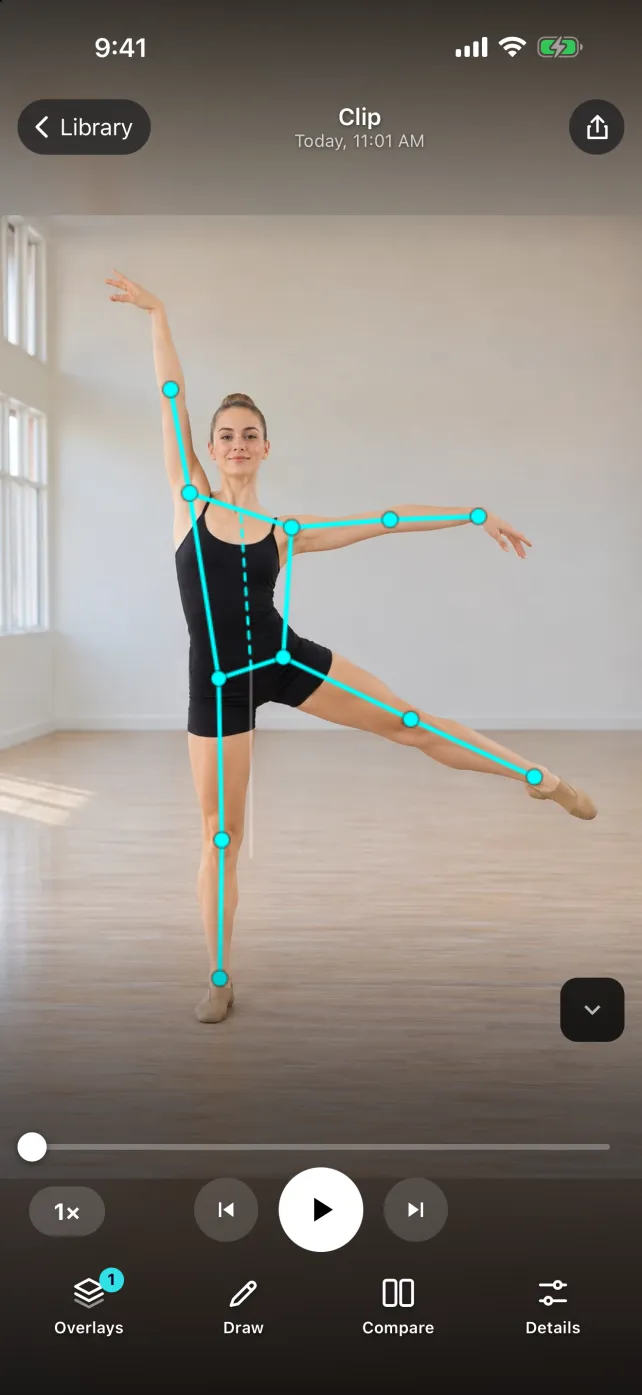
In the SportsDraw player, import your own practice clip, slow the movement and step through a visible transition. Use a drawing to identify the position you mean, then compare two takes and keep the count and orientation in a note. The comparison workflow uses manual clip selection and positioning. Do not assume automatic music synchronisation, mirrored tutorial playback, choreography recognition or a dance-quality score.
See what SportsDraw can do · See SportsDraw on the App Store
A two-dimensional recording cannot establish turnout, weight distribution or joint loading from appearance alone. Pose overlays are visual estimates and can lose a limb during turns, floorwork or overlap. This is a filming workflow, not a dance technique lesson, correction prescription or medical assessment. Follow your teacher’s instruction and the venue’s rules for music, recording and sharing.
Slower playback does not add frames that the camera never recorded. If contact is hidden or falls between frames, preserve that uncertainty in your note. See frame timing explained.
https://sportsdraw.app/posts/dance-practice-video-analysis-iphone
This worksheet stays in this page. Copy or print it to keep it; its contents are not sent to us.
Same eight-count phrase, audience view, both saved clips checked as unmirrored. On count five my right hand is outside the frame in take B, so I cannot compare that endpoint. Next question: can we move the camera back slightly for the next planned run while keeping the feet readable?
This article is published by the app developer as a filming-and-review workflow. Camera diagrams and example notes are illustrative. They are not athlete test results or an individual coaching assessment. Coaching context was checked against the primary resources below on November 8, 2026.
An event-specific primary example of audience-facing, landscape recording with the candidate visible throughout. This article adapts the visibility principle for private practice; it is not current examination submission guidance.
A camera plan for private gymnastics routine review: frame the full movement, preserve the approach and finish, and make a clear note for your coach.
Read the filming planFilm a skating sequence from an approved rink position, retain the entry and exit, and compare matched practice clips with a coach. Includes a review card.
Read the filming planAll sports video-review guides · Baseball and other practice articles